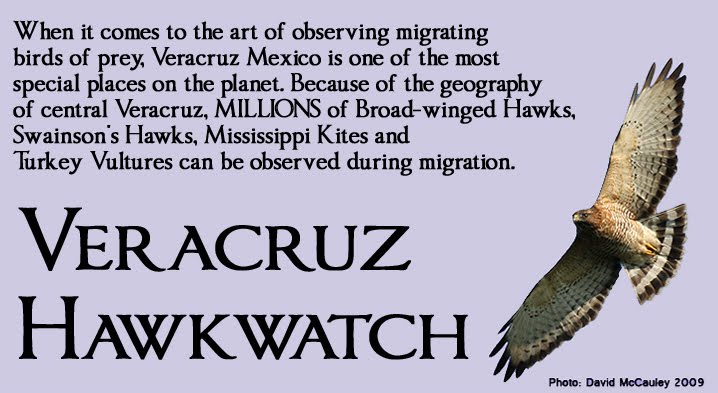
Saturday, February 21, 2009

Extreme Hawk Watch Veracruz 2009

This year I am dedicating four tour dates exclusively to the bird of prey migrations in Veracruz. In past years I have led tours where the time was divided between general birding and observation of raptor migration. This year I am going to show you the magnificent raptor migration in a way that few birders have ever witnessed.
video


The View
I have been observing the raptor migrations in Veracruz Mexico for 10 years now.
This year I am dedicating four tour dates exclusively to the bird of prey migrations in Veracruz. In past years I have led tours where the time was divided between general birding and observation of raptor migration. This year I am going to show you the magnificent raptor migration in a way that few birders have ever witnessed.


Here are the dates and prices:
Pre-register for the tours prior to June 1, 2009 and save 2o%

Tour # 1 - "The early migrants"...Extreme Hawk Watch August 27 - Sept. 9
**Number of raptors counted last year during these dates; 1919,529
Most abundant species Mississippi Kite, Swallow-tailed Kite, Osprey (12 raptor species observed)

This is the tour for the adventurous. 14 days, maximum of 6 persons.
Cost: $2,100
Pre-register and save $420.... $1,680 reduced cost

Tour # 2 - "Capturing the View" (Photographers Tour) Extreme Hawk Watch Sept. 16-25
**Number of raptors counted during thes dates last year; 432,612
Most abundant species:Broad-winged Hawk, Mississippi Kite, Turkey vulture, Osprey.(19 raptor species observed)
Special tour designed for photographers and videographers to catch the best views and angles of the Veracruz raptor migrations. 10 day tour. maximum of 6 photographers.
Cost: $2,500
Pre-register and save $500....$2,000 reduced cost


Tour # 3 - "The Spectacle of the Flow of Raptors" Extreme Hawk Watch Sept. 26 - Oct. 5
**Number of raptors counted during these dates last year 834,191
Most abundant species: Broad-winged hawk, Swainson's Hawk, Turkey Vulture (19 raptor species observed)
This is the tour for birders, educators and hawk watch enthusiasts. These dates provide the best "mix" of raptor species as well as spectacular views of Broad-winged Hawks in "kettles". 10 day tour. maximum 8 persons
Cost: $2,200
Pre-register and save $440....$1,760 reduced cost

Tour # 4 - "The late migrants, Swainson's Hawks and Turkey Vultures"
Extreme Hawk Watch October 16-25
**Number of raptors counted during these dates last year 678,309
Most abundant species Turkey Vultures, Swainson's Hawk (17 raptor species observed)
This tour I am calling the celebration tour... this is the final "push" of the Veracruz fall migration. The sky fills with lines and columns with hundreds of thousands of Swainson's Hawks and Turkey Vultures. 10 day tour maximum 12 persons.

Cost:$2,200
Pre-register and save $440...$1,760 reduced cost.


For more information:
David McCauley
hawkwatch@gmail.com


For more information contact me David McCauley hawkwatch@gmail.com

Friday, June 29, 2007

Population of Aplomado Falcon threatened in the Chihuahuan Desert


Please take a moment to read the following. I consider Angel Montoya to be a friend and a hard-working scientist for the Peregrine Fund. The following deserves our attention.
-David McCauley
Tlacotalpan, Veracruz


Friends and colleagues,*
**
*Over the years you have all either been directly involved with
or interested in the Aplomado Falcons of Chihuahua, Mexico. I am now writing
because although you may not know it there is currently a clear and imminent
threat to the grasslands, grassland birds, pronghorn, and Aplomado Falcon in
Chihuahua as we know them today. Unfortunately, the aforementioned threat is
happening at an alarming rate and there does not seem to be an end to it.*
**
*Please read the attached article by Duarte, Rodriguez, Montoya, Cade, and
Hunt on the destruction of Chihuahuan Desert grasslands and its consequences
to the survival of the last known Aplomado Falcon population in the
Chihuahuan Desert. As you all know this not only affects Aplomado Falcons
but other species ( pronghorn, grassland birds, etc..) as well. Please feel
free to forward this information to others. For more information or
suggestions you may either contact Grainger Hunt at
grainger@peregrinefund.org, Alberto Macias at maciasduarte@yahoo.com.mx, Tom
Cade at tcade@peregrinefund.org, Roberto Rodriguez at
beto2rodr1@gmail.com or myself Angle Montoya at
abmontoya@zianet.com . For additional articles on the Aplomado Falcons in
Chihuahua please visit the website:
http://www.peregrinefund.org/aplomado_articles.asp . You may also post this
on any list servers you see as appropriate. *
**
*If you respond please do so individually. Thanks and I apologize if you
have received this in duplicate.*
**
*Angel Montoya*
*The Peregrine Fund*
*100 East Hadley Ave.*
*Las Cruces, NM 88001

Here is the text of the pdf. file
*

FARMING ON GRASSLANDS POSES EXTIRPATION RISK TO APLOMADO
FALCONS IN CHIHUAHUA, MEXICO
Alberto Macías-Duarte, Roberto Rodríguez-Salazar, Angel Montoya, Tom Cade,
and Grainger
Hunt
The last known desert-dwelling Aplomado Falcon population (Falco femoralis
septentrionalis) in North America may be extirpated within the near future.
We have studied and worked to
conserve this relict population in Chihuahua for the last fifteen years, and
we feel a responsibility
to inform the international community of the recent and ongoing destruction
of the falcon's
breeding habitat through the plowing of native grasslands.

The Aplomado Falcon is a strikingly beautiful, endangered species that once
occurred throughout
the grasslands of the Chihuahuan Desert. In the 1800s, the population
extended northward into
the southwestern United States, but it disappeared there entirely by the
1950s and has since been
reintroduced in Texas. This is one of only two areas in Mexico where this
endangered species is
known to breed, one along the eastern coastal savannas from southern
Tamaulipas southward and
the other in the desert grasslands of Chihuahua. The distance between those
populations is about
one thousand kilometers.

When we began studying the Chihuahua population in 1992, there were
thirty-five known pairs, but the long drought of the 1990s and early 2000s
reduced the population to about twenty-five
pairs. At that time, we identified grassland desertification as the major
threat to the long-term
survival of the species (Macias-Duarte et al. 2004. The Auk 121:1081-1093).
We could not
foresee, however, that in the next few years, the species would face the
destruction of its breeding
habitat by the sudden conversion of desert grassland into croplands.

Native grasslands in Tarabillas valley

Just as the remnant falcon population in Chihuahua began to respond to the
recent increase in
rainfall, Mennonite farmers began buying the grassland portions of the
ranches inhabited by
falcons within Tarabillas valley, north and east of Sierra El Gallego, in
the municipality of
Ahumada. At a recent meeting with government authorities, we discussed the
loss of seven
Aplomado Falcon breeding territories to plowing. Officials informed us that
farmers are buying
"…every available hectare of native grassland in the area," including
additional known
Aplomado Falcon territories. The farmers continue negotiations with
landowners to buy all the
grasslands within that valley including communal lands (ejidos), and if left
unchecked they will
eventually own and farm the entire Tarabillas valley. These purchases are
facilitated by the fact
that most grasslands are in poor condition following the drought and its
consequences on
livestock production, tempting many landowners to sell their land to
farmers.

The Mexican Institute of Water Technology measured aquifer recharge rates at
37 million
m3/year from which CONAGUA (the agency responsible for
monitoring/controlling water
utilization) determined that ground water pumping could support 5,300
hectares of crop
production in the Tarabillas Valley on a sustainable basis. About 10,200 ha
are already under
ground-water irrigated crop production, and 20,400 hectares have been
ploughed in preparation
for crop production. In all, 59,900 hectares of grassland have been sold for
conversion to crop
production in just the last four years. Ground water pumping at current and
projected rates is
clearly not sustainable. Meanwhile, a substantial portion of the last
remnants of desert grasslands
known to support Aplomado Falcons in Chihuahua are being destroyed for
short-term profit from
unsustainable agriculture.

Today we know of only 18 Aplomado Falcon pairs remaining in Chihuahua, a
trend that suggests
the possibility of extirpation within a few years unless immediate action is
taken to stop the rapid
conversion of native grassland to cropland. In the last year alone, the
breeding territories of seven
pairs have been lost to the plow. We have found no evidence of Aplomado
Falcons in other
regions of Chihuahua, and surveys in Durango and Coahuilla have also been
unsuccessful.

The Aplomado Falcon is not the only species risking extirpation from this
portion of Mexico. The
endangered Mexican pronghorn (Antilocapra americana mexicana) lives only in
native
Chihuahuan grasslands and will share the same fate as the Aplomado Falcon if
farmland
conversion continues in Tarabillas valley during the coming months. Both
Aplomado Falcons
and Mexican pronghorns are closely associated with open grassland.
Pronghorns move along
grassland corridors, and the farming of these grasslands will further
fragment their already
diminished populations. Tarabillas valley is an internationally important
wintering ground for
migratory grassland birds from the northern United States and Canada; the
density of grassland
birds during the winter far exceeds that observed in other grasslands in
Chihuahua (Mendez-
Gonzalez 2000, Master's Thesis, Universidad Autonoma de Chihuahua).

Farms in the northern half of Tarabillas Valley have thus far destroyed
seven Aplomado Falcon
breeding territories.

Pronghorn antelope in native Chihuahua grassland

For further information, contact Alberto Macias-Duarte
(maciasdua...@yahoo.com.mx );
see
www.peregrinefund.org/aplomado_articles.asp for details about the Aplomado
Falcon population
in Chihuahua. Directors of the Mexican federal agencies involved in
environmental protection
include Juan Rafael Elvira Quesada, Secretary of Environment and Natural
Resources
(c.secretario@semarnat.gob.mx ) and Ignacio Loyola Vera, Federal Attorney
for Environmental
Protection (iloyola@profepa.gob.mx).

--

Tuesday, April 10, 2007

Video of Great Black hawk and Aplomado falcon


On April 10, I went out digiscoping in the morning and was able to capture some photos and a couple of short video clips. The first raptor is the Great Black Hawk - Buteo urubitinga ridgwayi. The photos and short video clip were taken with my Nikon Coolpix P1 handheld to my Nikon Fieldscope II 82mm with 30X wide angle eyepiece and Slik tripod. (Digiscoping)


The second raptor that I was able to photograph was the Aplomado falcon - Falco femoralis
I love Aplomado falcons! This is like the coolest raptor that I have ever observed! I came upon this female Aplomado falcon that had just caught a field mouse.
(the photo is a bit blurry but you can make out the the furry shape of the mouse in the Aplomados´s talons.) The video shows the Aplomado cleaning its bill.


Friday, May 19, 2006


A story of an Aplomado falcon family in Veracruz.
Here goes.....I finally have some information and photos to share with you.
I live in Tlacotalpan Veracruz (the tropical lownds/wetlands of central Veracruz)
Here is a timeline to the Aplomado nesting activities.
First spotted
I spotted/digiscoped the female Aplomado falcon on April 3, 2006

Eggs laid
As close as I can tell the eggs were laid on or around April 6, 2006

First Aplomado "chick" hatched
On May 8, 2006 the first Aplomado falcon chick hatched

Nest discovered
the nest was discovered by Angel Montoya field biologist with the Aplomado Project -The Peregrine Fund and myself on April 24, 2006

Second Aplomado chick hatches
The second "chick" hatches May 11, 2006
in addition eggshell samples were taken from the nest and the nest was photographed by field biologists from The Peregrine Fund.

Observations begin
Since May 13, 2006 (time allowing) I try to get out to the site and observe the nest and Aplomado falcon behaviours twice a day, 1.5 hours in the morning and 1.5 hours in the afternoon.


Now for the photos. (just click on the highlighted links below to see photos) Note with regard to photos:
Unless otherwise noted ( see the Peregrine Fund photos),
these are my photos and may be copied for personal/educational use. Commercial use of my photos requires my permission.
David McCauley
hawkwatch@gmail.com

The power of "digiscoping". This PHOTO shows the magnification possibilities of "digiscoping" (a digital camera coupled with a spotting scope)
Without the "digiscoping" setup I would never attempt to photograph the nest.
Here are some images of the "lay of the land" and where I am in relation to the nest and observation perches of the Aplomados.
VIEW1
VIEW2

Some ID observations on the Aplomado falcons
Here are some photo charts that help show some of the field marks and differences between the male and female Aplomado falcons.
FEMALE APLOMADO
MALE APLOMADO
M/F Size Comparison

Meeting the Aplomados
Since I am in Mexico I have named the pair of Aplomados after the Maya dieties "Itzamna" and "Ixchel" SEE PHOTO

The NEST is either that of a Brown Jay, Roadside Hawk or possibly a Northern caracara, Aplomado falcons do not build nests but instead depend upon the nest building skills of others.

The nest photographed.
Here are photos of the nest with one "chick" hatched (approximately 3 days old) and the second "chick" is just breaking its way out of the egg. The reason for climbing up to the nest,(hence the photo) is a joint project of The Pergrine Fund and USGS with the end of collecting eggshell fragments and infertile eggs for testing of pesticide/herbicide levels. This is a good thing, field biology at work, a proactive approach to study unregulated pesticide use in Latin America. (DDT is still sold here in Mexico and is in no way regulated.) Hmm.
These photos were taken by a field biologist of The Peregrine Fund and have been used here with their permission. (These images are property of The Peregrine Fund and may NOT be copied or reproduced without their permission.) I am most grateful to The Peregrine Fund for the use of the photo on my weblog. Plese keep in mind that the photos taken is a result of a field study. Please, it should go without saying but- DO NOT CLIMB TREES OR USE MIRRORS ON POLES in order to photograph nesting chicks or egg clutches.
PHOTO 1
PHOTO2
PHOTO3

Ixchel and Itzamna on the nest.
IXCHEL (female)
ITZAMNA (male)

The feeding of the Aplomado Chicks.
PHOTO1
PHOTO2
PHOTO3
PHOTO4
PHOTO5
PHOTO6

So there you have the basics of the family of Aplomado falcons in Tlacotalpan Veracruz Mexico. I will as time allow continue to post photos of the progress of the young and share with you some of my field notes/observations.
The Aplomado falcon population was nearly eliminated in the US due to loss of habitat and pesticide contamination.
Thanks to the ongoing efforts of The Peregrine Fund with their Aplomado Falcon Project, the species in now being successfully re-introduced into its former breeding habitats.
I would encourage all who can, to actively support this ongoing project.

David McCauley
hawkwatch@gmail.com

Tuesday, May 16, 2006

The Aplomado falcon nest is discovered!
On April 23, 2006 I am sitting out on the porch conducting the spring hawkwatch here in Tlacotalpan and I am approached by a group of people that look like birders... My guests are Angel Montoya, his wife Jennifer and son Woodrow together with Angel's sister and brother in law. Angel tells me that he and his family are here on vaction and that he works for the Peregrine Fund and his wife Jennifer works for the World Wildlife Federation.
Instant camaradeire.
Anyone who gives a damn about nature is a friend of mine.
As I talk more with Angel he tells me that he is a field biologist with Peregrine Fund working on the Aplomado falcon restoration project in the US. How cool is that?
I am the captive audience with a thousand questions!
That afternoon Angel and myself sat on the porch, drank a couple cold beers and counted migrating raptors 5,248.....among them 5,010 Mississippi kites, 16 Peregrine falcons, 13 Turkey vultures, 4 Ospreys, 1 late Swallow/tailed kite, 196 Broad/winged hawks, 6 Swainsons hawks, 1 American kestrel and a Partridge in a pear tree!
In the course of the conversation I mentioned that I had been "digiscoping" Aplomados nearby and asked him if he wanted to go birding the next morning. Angel agreed and early the next morning we headed out to my local patch to bird.
Note. I live in central Veracruz in the tropical lowlands.
The next morning Angel showed up on time, and we headed out to bird. When we got to the area where I had been photographing Aplomado falcons, I scanned the fence line and we found the Aplomado nest!


I was really excited, this is the first time in my life that I had ever seen a nesting Aplomado falcon!
The Aplomado falcon family and sharing them with the world.
It is after careful consideration that I start this series on the Aplomado falcon on my weblog.
It was two years ago here in Veracruz, that I had a memorable encounter with a pair of Aplomado falcons. I was out birding/digiscoping and I heard a commotion, it was two Aplomado falcons giving a good "get the hell out of my territory" message to a Roadside hawk. Unforgettable. The Roadside hawk retreated to more hospitable terrain. I observed the pair of Aplomado's in my binocular and was able to "digiscope" with my rather rustic setup of a basic Nikon spotting scope and my 2 megapixel Sony Mavica 250CD.(after vingetting I was lucky to get a good 4X6!)
Suddenly one of the Aplomado falcons shot off of the branch where it had been perched, almost immediately the second Aplomado falcon followed. I saw it all in my binocular.
The first Aplomado was in rapid pursuit of prey, the prey headed for the nearest leafy tree.
As the prey entered the safety of the tree the first Aplomado shot up into the air and hovered/"kited" above the tree.
The second Aplomado, (which was not far behind) went directly into the tree pursuing prey.
An Aplomado falcon is an undisputed master of airspace for its aerial acrobatics, but put them into a tangle of branches and they do not do well! So I observe this Aplomado foundering in a tangle of branches....the prey (a juvenile Eastern Meadowlark) seeing its attacker clumsily flapping in the branches sensed the opportunity to escape and flies from the refuge of the tree. BIG MISTAKE.
The first Aplomado falcon which had been hovering above the tree, saw the escaping flight of the juvenile Eastern Meadowlark and deeply swooped to make a definitve "kill".
I had just witnessed what must surely be one of nature´s greatest "dramas"....the cooperative hunt of the Aplomado falcon!
This colorful, long-tailed falcon had made unforgettable impresion on me. I was hooked!
I began to study all the material that I could find on this amazing bird of prey.
I recently crossed paths with a family of Aplomado falcons here in Tlacotalpan Veracruz, Mexico where I live. What I hope to do over the next several weeks is share with you images as well as information regarding Falco femoralis - The Aplomado Falcon.


Here is the image a provoked a renewed interest in the Aplomado falcon. While conducting my annual spring hawkwatch here in Tlacotalpan, I had Dane Ferell (of the Corpus Christi Texas Hawkwatch) here with me helping me with my spring raptor migration count. One morning (April 3, 2006) we were out birding before the hawkwatch and we came across this female Aplomado. I digiscoped a few pictures. (For those who may not know "digiscoping" is a is a photography technique that couples a digital camera with a spotting telescope. In the birding world the late Laurence Poh is considered to be the "father of digiscoping". Laurence eagerly shared with many his techniques, which have revolutionized nature/bird photography. Thanks to this recent technology, it is now possible to photograph most birds from a considerable distance and still capture their behavior and visual characteristics without "stressing" the bird.
Unless otherwise noted my photographs of the Aplomado falcon have been "digiscoped" using a Nikon Coolpix P1 (8megapixels) camera handheld to a Nikon Fieldscope 82mmED with a 30XWide Angle eyepiece, with either a Slik or Gitzo tripod.
So the journey begins of the Aplomado falcon family in the spring of 2006 in Tlacotalpan, Veracruz Mexico.
David McCauley
hawkwatch@gmail.com

Thursday, May 04, 2006

Thursday, April 27, 2006


Yesterday afternoon here in Tlacotalpan Veracruz in a three hour period, I was able to count 5,675 Broad-winged hawks. There had been a bit of a lull in the movement of Broad-winged hawks here at the count but today they made a good showing.


In the morning yesterday I was able to "digiscope" this cool Yellow-headed Savannah Vulture (lesser)
The Savannah vulture is a resident here in Tlacotalpan, Veracruz. In flight they resemble a Turkey vulture.

-David McCauley


On April 25, 2006 Twenty-three Peregrine falcons flew over the spring hawkwatch in Tlacotalpan Veracruz.


I love to watch Peregrine falcons! Perched or in flight this is one damn impressive raptor! In recent days they have been migrating through in fairly large numbers. We have observed and counted 65 Peregrine falcons in the last seven days. So far this spring we have counted 136 Peregrines.
On April 25, in the afternoon, this beautiful Peregrine falcon landed on a radio antenna (two blocks from the hawkwatch site) I left Rafael and José Luis counting, grabbed my scope and digital camera, and was able to get a few photos of this Peregrine falcon at rest.
Enjoy.
David McCauley
hawkwatch@gmail.com